

Painted Over: Are You Next?
What a female Renaissance painter can teach us


Legacy is preserved by those who deem the story important.
Even incredible, powerful stories decay when neglected.
In 2018, a historian discovered a damaged, discolored painting in a storeroom at Hampton Court Palace. A rendering of the biblical story Susanna and the Elders, this painting was attributed to a male artist over two-hundred years ago, and then thought to be “French School,” a general term used by art historians to refer to a French style where precise attribution is not possible.1
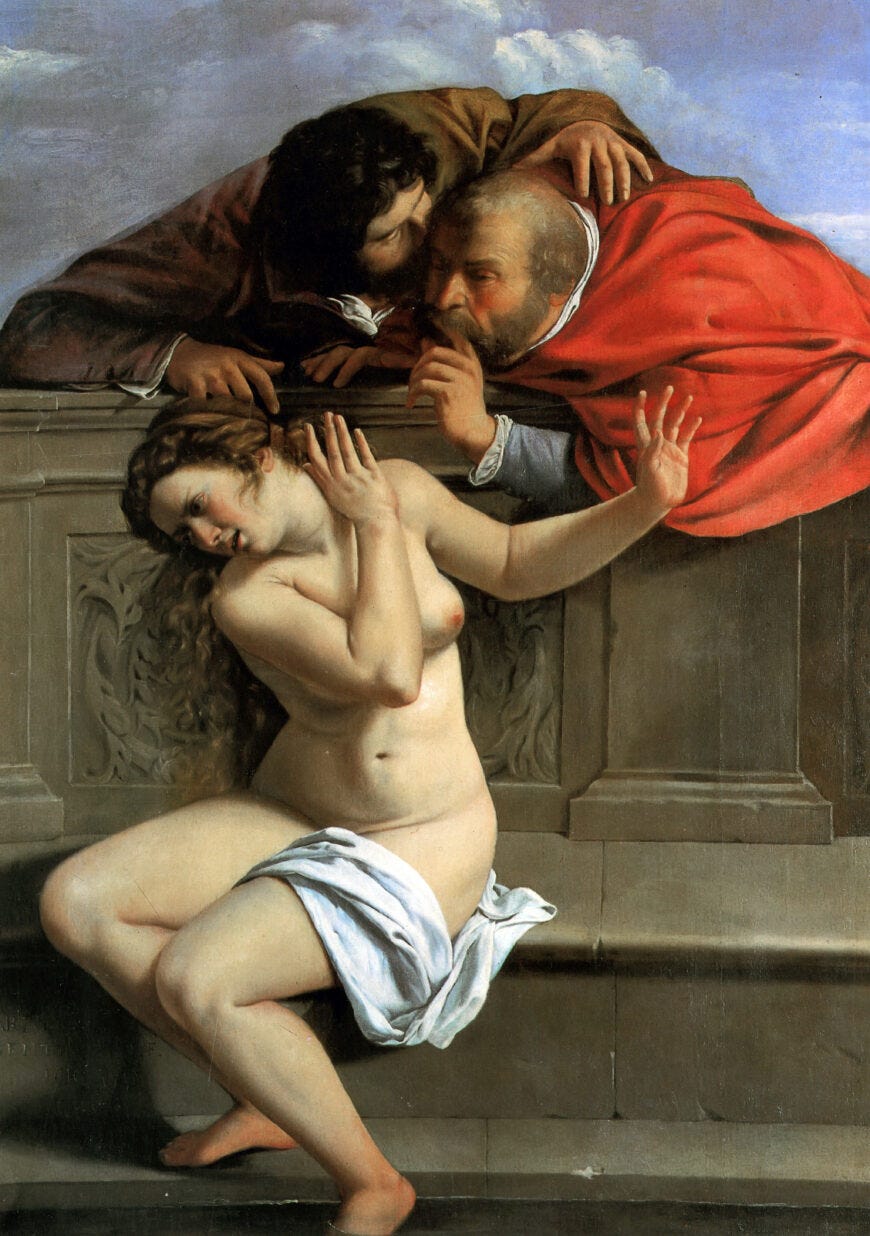
Having been heavily painted over and covered with grime, this painting had been tossed in an old storage room, forgotten with time.
If this isn’t a metaphor for women’s history, I don’t know what is.
This painting was an Artemisia Gentileschi. One of the most important artists of the Renaissance, she was one of the few successful women artists who worked with the highest courts in Europe.
Her powerful work screams feminine rage, emotions that still resonate nearly four hundred years later. She completed Susanna and the Elders in 1610. A year later, she survived a rape by her father’s acquaintance.2 This resulted in a brutal trial where the court subjected her to torture through thumb screws, used as a vicious lie detector to verify her testimony.3 Though he was convicted and banished from Rome for five years, the man never paid his sentence—shocker.
Her paintings reveal the pain of this experience, but from a place of power. Art teachers will tell you how Artemisia’s story lands harder for the women in their classes. They suddenly feel closer to art, knowing someone like Artemisia left her mark. We’ve been told that only male artists have been talented enough to be celebrated, but then we see Judith Beheading Holofernes:
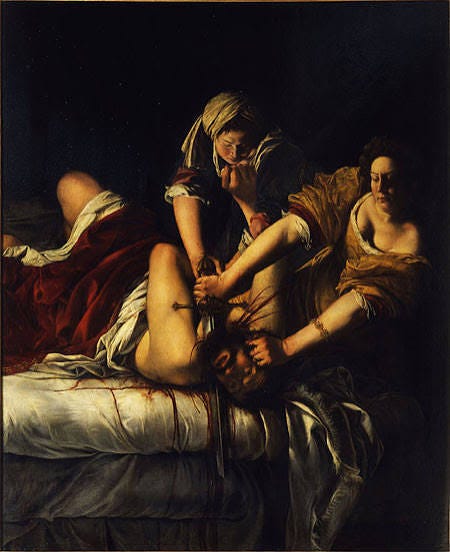
The woman is powerful. Resolute. Body leaned in, blood splattering her dress, she makes no apologies for the beheading. A different depiction than Caravaggio’s version, where Judith leans back, timid and hesitant in a pristine white blouse. She painted Judith as the main character, not an afterthought.
In Gentileschi’s version, we feel her rage.
Yet her painting was once misattributed to Caravaggio. Several of her works were attributed to her father or his students. History buried this incredibly talented artist. Historians washed away her art and handed to the credit of men in her life. They scrubbed her name from celebrations of inspirational Baroque artists.
Neglect erased her and damaged her art. Literally.
The rape and trial often overtake her narrative, but Artemisia’s art reflected the full story of womanhood. Powerful, resilient. She was the first woman admitted to Florence’s Academy of the Arts of Drawing in 1616.4 She built a successful workshop all on her own.
In a letter to a patron she wrote, “You will find the spirit of Caesar in the soul of a woman.”
This is how many women feel. Burning inside with ambition and power, yet holding the truth that the male-dominated world expects us to soften. That society discourages achievement or wealth. Ultimately, they teach us that autonomy is a failure. “The soul of a woman” to me suggests that we are multitudes. Soft and gentle, loving and kind, but also ruthless and commanding. History has never afforded us layers. Society never allows us to be complicated. They were too focused on making us compliant.
Artemisia’s story is about so much more than her trauma. It is one of creative genius, triumph, and love. Her art contains all of the emotions, and we feel them when we look at her work.
By erasing her, we erase the story of womanhood.
Modern historians continue to bring her work into the spotlight. Her paintings now sit at the Uffizi, the National Gallery in London, the Getty, and the National Gallery of Art.
People often ask me why I care so much about women’s history. That is a question I’ve never fully been able to answer, but Artemisia’s legacy says it all. When powerful men erase a woman’s voice, leave it to rot in the darkness, only kept relevant and vibrant when it’s attributed to a man, her brilliance becomes a discovered gem. A rarity. I argue brilliance was everywhere in women’s history. Sure, Artemisia’s art is special. Her work important. But how many other women made beautiful contributions to the world, and we will never know?
When we raise our children to see women thriving, they will know it is not just possible, but normal. We learn to see women’s voices as necessary. Statements about womanhood, whether through art or text or even silence, still provoke hate. Fear. Dismissal. Of course they do. Art like this was too powerful for the world to celebrate, so we slathered it in layers of acceptable paint and rewrote the story of the artist to better fit our narrative.
This leaves a black hole for men of history to fill in with what suits them. What promotes their place at the top of the food chain, where they can relegate women like her to obscurity.
Artemisia’s life and work must outshine her trauma.
It’s why I write the stories I do. Our trauma is a piece of our puzzle. It’s often glamorized and sensationalized because rage gets hits. But I want to celebrate the quiet power of choosing yourself. Of triumph. Allow the world to hate you, because you know what you were put here to do. I highlight the women who loved themselves so fiercely they let everyone’s expectations fall like dead leaves at their feet. We can’t stop the world from throwing fruit, but we can wipe away the mess and keep walking forward.
Maybe our story gets buried in a dusty storeroom. Or maybe a historian discovers us someday and sees what we did and the bravery it took. Either way, we must do it for ourselves. For the women who remain buried and silenced. For our daughters. For a world that may not be ready for us yet.
When they erase us, they get to craft our narrative. It’s why our experience is so unique. We’ve lived under the great sense that our courage and power brew deep below the surface, but we can never really extinguish it to fit the mold society expects.
Words, art, and representation carry enough weight for powerful men to panic at their existence. Be the power they’ve tried for centuries to eliminate. Be louder. Write your own damn narrative. Never let the hate stop you or the resistance fade your brilliance.
You’ve got a story to tell.
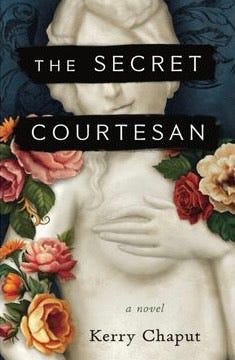
Thank you for reading. If you want more women erased from art history, please buy my book, The Secret Courtesan, inspired by Artemisia’s story and fueled by all the artists still forgotten in storerooms all over the world.
**Kindle sale! $1.99 through 7/6.
https://www.rct.uk/about/news-and-features/lost-artemisia-gentileschi-painting-rediscovered-in-the-royal-collection
https://www.nationalgallery.org.uk/artists/artemisia-gentileschi
https://www.smithsonianmag.com/arts-culture/artemisias-moment-62150147/
https://www.nationalgallery.org.uk/paintings/artemisia-gentileschi
Artemisia was a stunning talent. There are several plays about her life and the challenges she faced. Kate Hammil (sp) wrote one that received very positive reviews. I've not read it, but your article stirred memories for me. I had a theater company in the late nineties just off the West End and we were considering doing a performance based on a novel written about Artemisia. Perhaps it is time to dust off those intentions.
Thank you for sharing her story and those of other women artists who have been ignored or otherwise denied